
Final Survey
Executive Summary
This November, Iowans will enter their local community centers, school buildings, and even some businesses to cast their ballots in city and school elections. Many communities have special elections coming up, and the June primary elections leading to the midterm elections in 2026 are on the horizon for many Iowa elections officials and candidates.
No matter the election, Iowans have many different methods when it comes time to cast their ballots.
- Through absentee voting, voters can complete their ballot at home and return it through the mail or at their county elections office.
- Voters can vote early in person at their county elections office in the days leading up to the election. This is a form of absentee voting.
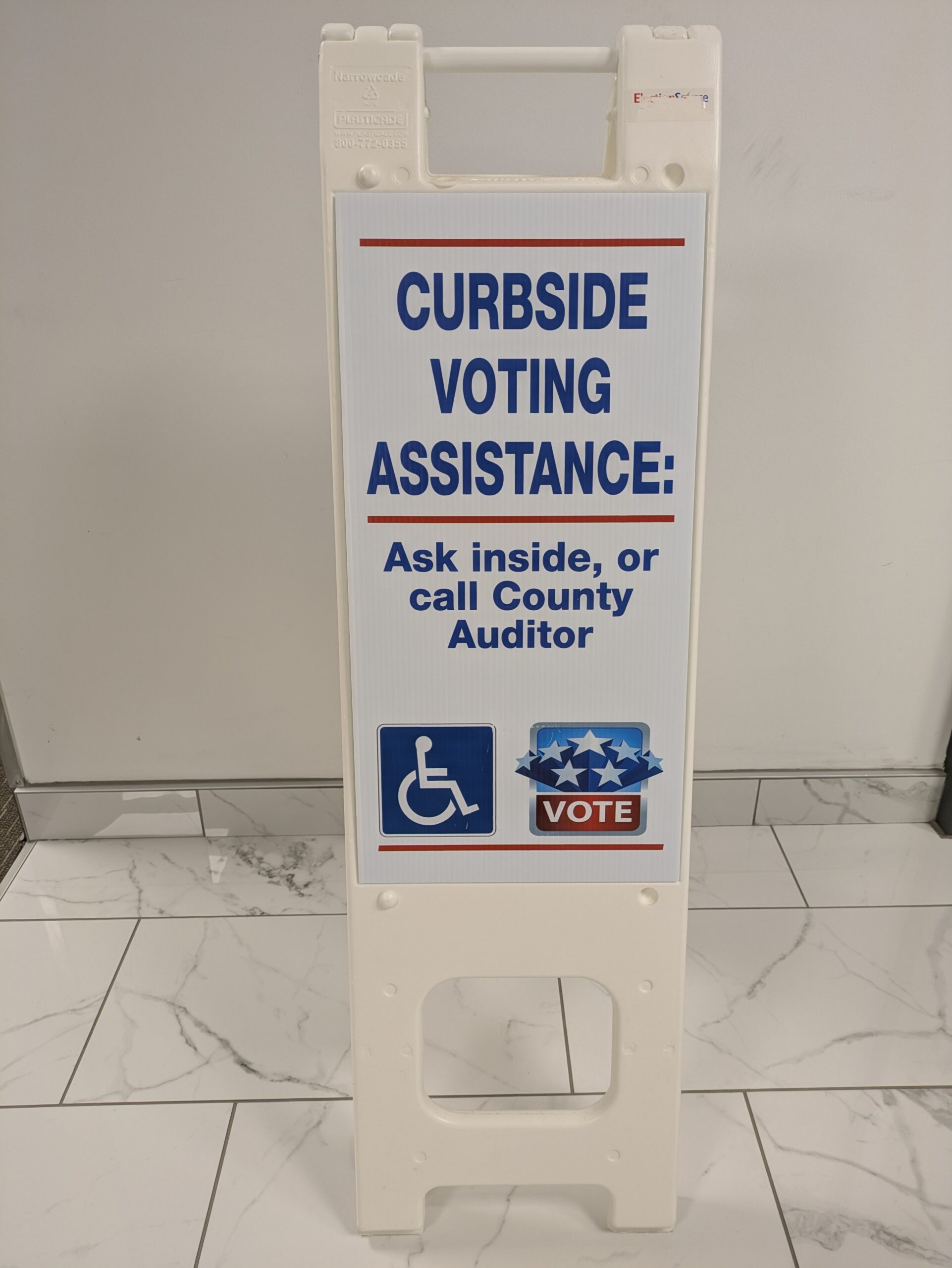
- Many Iowans choose to vote in-person on Election Day. Iowans with disabilities can use curbside voting in-person on Election Day at their polling place.
Whether Iowans with disabilities head to their polling place on Election Day, or they cast their ballot early at their county elections office, the Americans with Disabilities Act requires that their voting location be accessible.
From June through September 2025, Disability Rights Iowa reviewed 144 polling places in all 99 counties across the state. These reviews focused on the exteriors of the polling places: parking, pathways, and entrances. Of the locations reviewed:
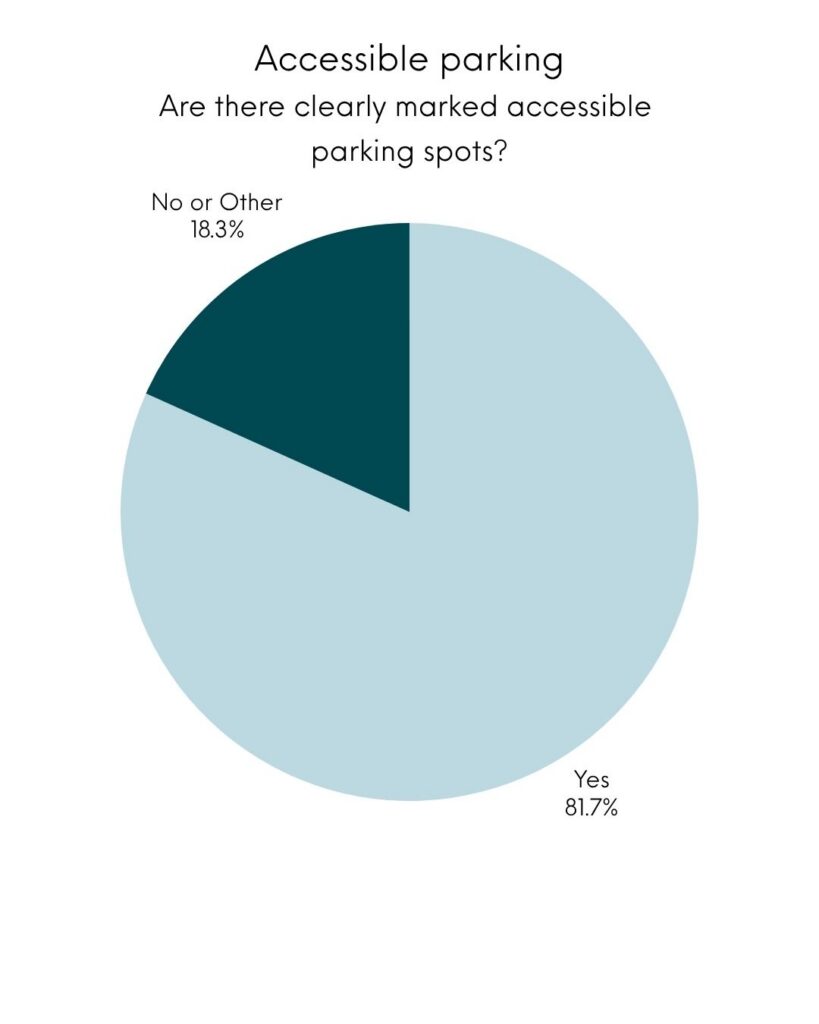
- 82% had an adequate number of properly marked accessible parking.
- 81% had pathways that were flat and clear of cracks, potholes, or steep slopes.
- 78% had building entrance thresholds that were accessible.
There are approximately 1,600 polling places across the state of Iowa, the 144 locations DRI reviewed constitute about 1% of the state’s polling places. This report offers a broad view of the exterior of Iowa’s polling places surveyed and outlines the ADA’s requirements that ensure voters with disabilities can access the vote.
This review covers only a small measure of accessibility throughout the voting experience. Other aspects of voting accessibility include physical accessibility inside the polling place, ensuring accessible ballot-marking devices are set up, and making sure the contents of the ballot are accessible for individuals with cognitive disabilities.
Background
Beginning in 1965, several federal laws were implemented to ensure that Americans with disabilities have equal opportunity to vote. These federal laws are:[i]
- The Voting Rights Act of 1965
- The Voting Accessibility for the Elderly and Handicapped Act of 1984
- The Americans with Disabilities Act of 1990
- The National Voter Registration Act of 1993
- The Help America Vote Act of 2002
Title II of the Americans with Disabilities Act (ADA) ensures that all U.S. citizens with disabilities have a full and equal opportunity to vote. This includes all parts of the voting process, from registration to ballot-casting.
On July 27, 2025, Americans celebrated the ADA’s 35th year. Despite this landmark federal disability civil rights law, individuals with disabilities still encounter barriers in the voting process. A 2022 Rutgers survey sponsored by the US Election Assistance Commission found that 14% of Americans with disabilities had trouble voting in that year’s election, compared to 4% of Americans without disabilities[ii]. The study found a 1.5% gap in turnout between voters with disabilities (50.8%) and voters without disabilities (52.4%). The survey found “if people with disabilities voted at the same rate as people without disabilities who have the same demographic characteristics, there would be about 2.0 million more voters.”[iii]
A July 2024 report found that 402,615 Iowans report having a disability, which totals about 12.8 percent of the population. As many as 29.9 percent of Iowans 65 and older report having a disability.[iv] The disability community is one that anyone can find themselves a part of at different points throughout their lives. Lack of accessibility is a concern for all Iowans.
Survey of Iowa polling places

Figure 1
A map displaying 99 counties Disability Rights Iowa visited during the polling place audit.
TEMPLATE COURTESY OF THE IOWA DEPARTMENT
OF TRANSPORTATION
Types of polling places in Iowa
In 2024, DRI reviewed all state auditor websites to review the different types of buildings that serve as polling places in Iowa. Government buildings, such as city halls, courthouses, and community centers, are common polling locations. Churches also constitute a great number of polling places across the state. Some Iowans cast their votes at private businesses, including hotels and private event centers. Some of these businesses and all churches are exempt from the ADA during regular operations.
Common barriers
When churches or other ADA-exempt organizations act as polling places on Election Day, they must modify all barriers to access that exist. The Department of Justice’s Civil Rights Division reports the following five physical areas as having unique accessibility considerations[v]:
- Parking
- Pathways (sidewalks and walkways)
- Entrances
- Hallways
- Voting Areas
DRI reviewed the exteriors of polling places; thus, this report focuses on parking, sidewalks and walkways, and building entrances.
Iowa polling place survey results
In reviewing a polling location for exterior accessibility, DRI accessed the parking, pathways to the entrance, and the building entrances.
Parking
Accessible parking is reported to be one of the biggest barriers Americans with disabilities experience. According to the Accessible Parking Coalition, 69% of Americans who utilize accessible parking say they have trouble finding accessible parking at least half of the time.[vi] Polling places that offer off-street parking must follow ADA standards for accessible parking outlined below.
ADA requirements

At the polling site where off-street parking is offered, the ADA requires that 1 in 25 parking spots be marked as reserved for accessible parking. To be accessible, a parking spot must be clearly marked, “on a level area with no steep slopes and on the shortest accessible route from parking to the accessible entrance to the polling place[vii].” The spots should connect to a pathway so an individual who uses a mobility aid, like a wheelchair or a walker, does not have to enter a lane of traffic. Every polling place must have at least 1 spot for vans accessibility with a lane next to them. The access aisle must be at least 96 inches wide for vans, or 60 inches wide if the parking space itself is 132 inches wide.
DRI audit results
- About 82% of the polling places DRI reviewed had accessible parking lots.
- 104 of the 144 polling places had off-street parking available.
- 85 of those 104 parking areas were accessible:
- 1 accessible parking spot per 25 available spots
- Obvious signage and well-maintained parking lanes
- Set on level, stable, firm, slip-resistant ground
- Clear of gravel, mud, and weeds
- About 68% of the parking lots had at least one van-accessible parking spot.
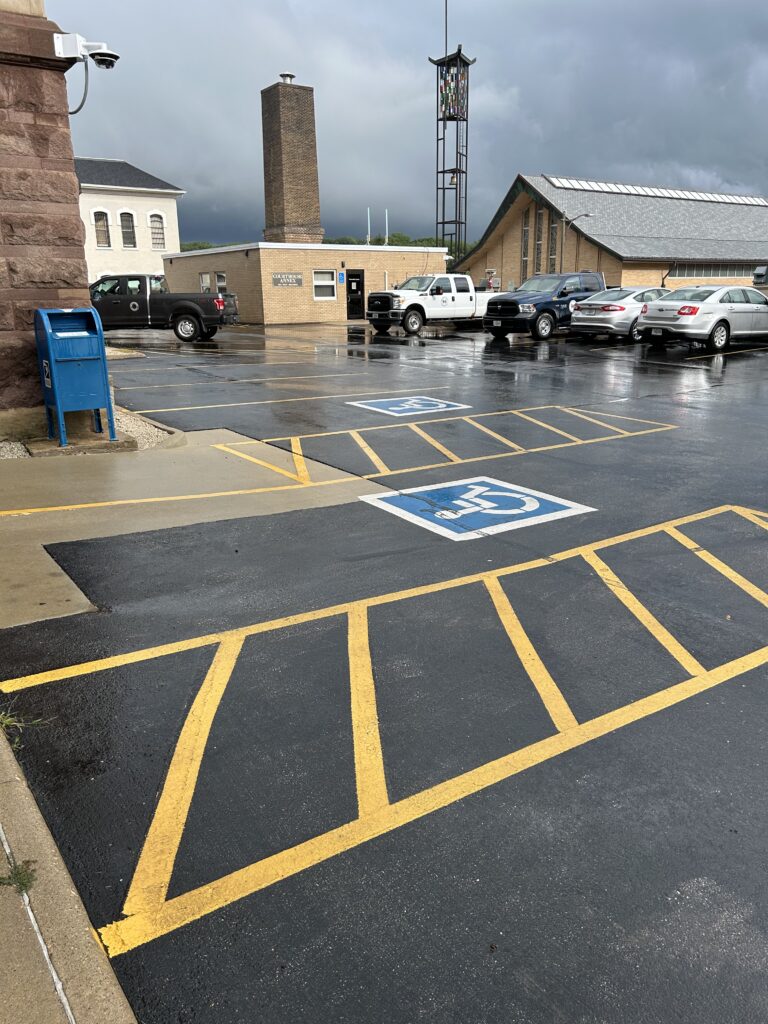
Of the 19 polling places’ parking lots that had accessibility issues, the most common problem was the accessible parking spots were not marked clearly. Other problems included accessible spots that were not on level ground and accessible spots that were not connected to the pathway, causing a person to move through a lane of traffic to get to the entrance of the polling place.
Possible ADA fixes
To comply with the ADA on Election Day, local elections officials must make temporary alterations to address accessibility barriers. Options include:
- Temporary accessible parking signs to add accessible spots
- Cones to protect temporary van access aisles
- Temporary plates covering potholes and cracks in asphalt or gravel

Pathways
Sidewalks and paths from the parking area to the building entrance pose another potential barrier for individuals with disabilities. Cracks, potholes, weeds, gravel, and other uneven surfaces all impact access, as do low-hanging tree branches, plant pots, trash cans, and other items. Individuals with vision and mobility impairments may not be able to travel from the parking area to the entrance with these barriers.

ADA requirements
The ADA requires that the path of travel from the accessible parking area to the accessible entrance be a path that is a minimum of 36 inches wide, stable, firm and slip resistant, and with no abrupt level changes, extreme slopes, potholes, or cracks.

DRI audit results
- 117 of the sites DRI reviewed, or about 82%, had accessible pathways from parking to entrance
- 27 of the sites had accessibility issues, including gravel, weeds and other easily removed debris; broken concrete or asphalt; missing curb cuts; a slope that is too steep; or objects protruding into the pathway. A few locations had pathways that were not 36 inches wide from the parking area to the entrance.

Possible ADA fixes
All objects along the pathway that may prevent accessibility must be removed, i.e., garbage cans, rugs, recycling bins, tree branches, etc.
If a pathway has a slope that is greater than 1 inch of rise over 20 inches, a ramp with a rise of 1 inch over 20 inches or less must be installed to mitigate these issues. If the path to the entrance includes a curb that does not have a curb ramp that is 36 inches wide with a slope of less than 1 inch over 12 inches of rise, this must be remediated as well. If a path contains a crack, pothole, or other barrier that is more than ½ inches, a temporary plate must be placed over it.
Entrances
Front building entrances with accessible features are a commonly overlooked issue. The front entrance is not always the accessible entrance to the building. Sometimes the accessible entrance is in the back or side of the building. Causing individuals with disabilities to travel around the side or back of the building to find an entrance that is accessible. This creates more challenges and safety issues. There are four main components of accessibility to the entrance of a building. It only takes one inaccessible component to make a polling place inaccessible to a voter with a disability.

ADA Requirements
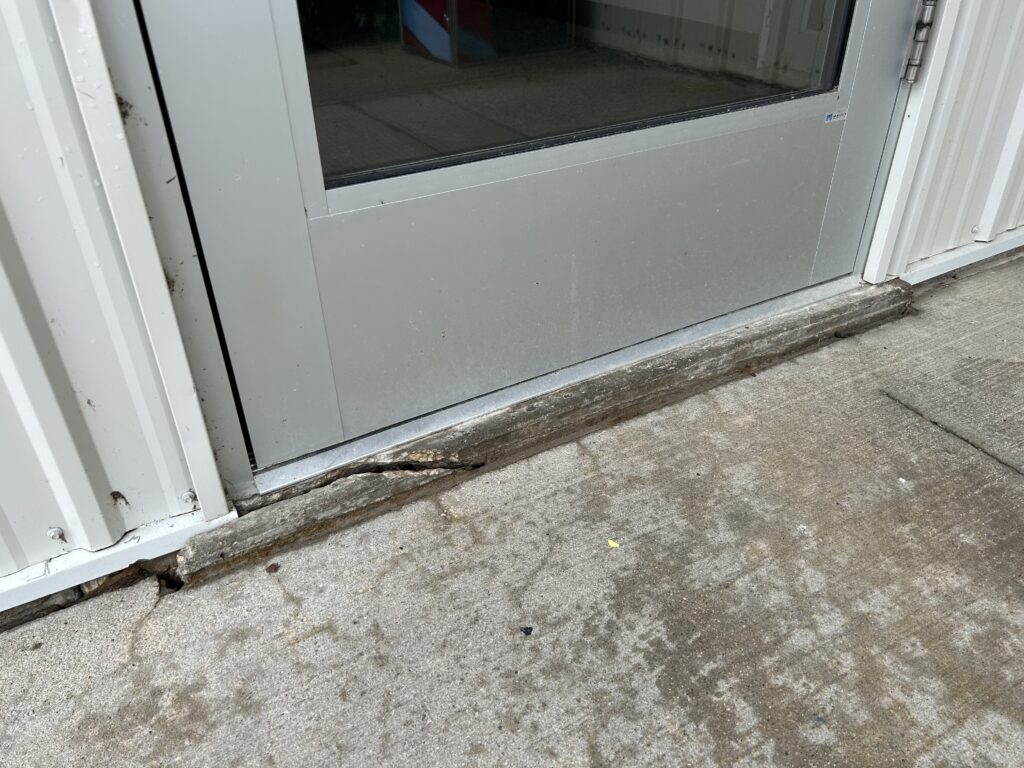
The entrance area must be level, flat, and should not slope steeply in anyone direction. All door openings must be a minimum of 32 inches wide. A person using a wheelchair must have enough space to maneuver through the door. This includes 18 inches minimum on the latch (door handle/knob) side of the door. The door hardware must not require tight grasping, pinching, or twisting, it must open easily without much effort (for example, you should be able to pull the door handle open with one finger easily). Lastly, the threshold must not be greater than ½ inch in height. A threshold is a strip of wood, metal, or stone forming the bottom of a doorway and crossed in entering a house or room.
DRI Audit Results
84% of main entrances also served as the accessible entrance.
- 23 of 144 entrances required individuals to use an alternative entrance for handicap accessibility
- 97.5% of entrances did not require the use of stairs, and 100% of entrances requiring the use of stairs had ramps
- 27 of 144 entrances contained a threshold more than ½ inch high and/or lacked a bevel (a piece of angled material to help a wheel get over a threshold easily)
- 7.6% of doors contained a lever or doorknob that required pinching or twisting
- 8.3% of entrances did not have a level area in front of the door
Other observations during audits included obstructive objects or poles in the area surrounding the doorway. One entryway included a post for automatic door-opening buttons; however, the placement of the post disrupted the entryway clearance. Steep slopes to the entrance and landings with concrete in a state of disrepair were other cited issues.
Possible ADA Fixes
ADA compliance emphasizes that accessibility can be achieved independently so that a person with a disability is not dependent on others for assistance. Temporary solutions to remove accessibility barriers on Election Day for entrances include:
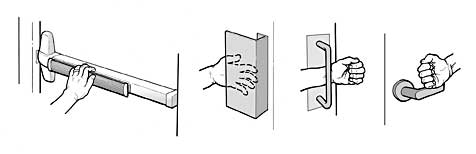
- Install temporary levers or other adapters that do not require tight grasping, inching, or twist.
- Install a doorbell or buzzer system to alter a poll worker to open the door for the voter.
- Prop open a door for the duration of voting hours (ensure the door stop mechanism does not interfere with the entrance width)
- Install temporary ramp that feeds directly into the entrance
- If the ramp height will be less than 6 inches, no handrails are needed
- If the ramp height will be more than 6 inches, handrails and edge protection are required
- Install a bevel where thresholds are greater than ½ inch.
- Direct individuals to a stairless (and otherwise accessible) entrance to the building
Other considerations
While this report considers the exteriors of Iowa’s polling places, it’s important to remember that the interiors of each polling place also must be accessible on election day, including pathways, elevators, and the voting area.
An issue commonly brought to Disability Rights Iowa’s attention is that voters who use accessible ballot marking devices arrive to their polling place to find that the accessible voting machine is not readily available for their use. Frequently, the accessible voting machine is on a cart, not plugged in and inoperable. Individuals who use accessible ballot marking machines are entitled to cast an independent and private ballot. Accessible voting machines must be readily available for use during Election Day. The accessible voting machines should be placed on a surface with clearance underneath for individuals using wheelchairs or other mobility devices. The accessible voting machines should be placed in an accessible area in the polling place.
In Iowa, voters with disabilities may use curbside voting on Election Day. With curbside voting, a voter parks in a spot that is specifically marked with a “Curbside Voting” sign and calls the phone number on the sign. Two poll workers, one representing each major party, will bring out a ballot for the individual to complete in their vehicle. Once the voter has completed the ballot, the two poll workers bring the ballot into the polling place and submit it with the rest of the ballots.

Recommendations
Disability Rights Iowa recommends elections staff at each polling location complete their own accessibility survey using the ADA polling place accessibility checklist. Interior accessibility is just as important as exterior accessibility, and elections staff are in a good position to thoroughly review the interior of each site.
Poll workers should promptly let their county auditor know if adjustments need to be made, like adding temporary plates, ramps, signage, or other tools that will ensure accessibility.
Disability Rights Iowa is a resource for staff who have questions about accessibility at their sites, from parking to the accessible ballot-marking device. For more resources with helpful descriptions and explanations about accessibility, review the “Resources” section of this report.
Resources
Disability Rights Iowa strives to be a resource for elections staff and individual voters. DRI welcomes general and specific inquiries about polling place accessibility. You can reach DRI with inquiries by filling out an online submission form at https://disabilityrightsiowa.org/online-intake-form/ or calling our intake line at (515) 278-2502. Below are additional references to consider:
- The Americans with Disabilities Act Checklist for Polling Places
- United States Election Assistance Commission Accessible Elections – Information for Election Officials
- The Iowa Secretary of State’s Elections Accessibility webpage
- Disability Rights Iowa’s Voting webpage
- Great Plains ADA Center
- U.S. Access Board
[i]
https://www.ada.gov/resources/protecting-voter-rights/
[ii]
Lisa Schur, Douglas Kruse, and Mason Ameri, “Disability and Voting Accessibility in the 2022 Elections: Final Report on Survey Results Submitted to the Election Assistance Commission,” May 2023.
[iii]
[iv]
https://www.iowadatacenter.org/application/files/4217/2054/2826/Iowanswith Disabilities2024.pdf Iowans with Disabilities: 2024; report by the State Data Center of Iowa, a program of the State Library of Iowa and the Office of Persons with Disabilities
[v]
https://www.ada.gov/resources/solutions-voting-problems/
[vi]
[vii]
